



Cross-sector partnership seeks support for a pan-European system to keep fake drugs out, but obstacles are many.

Cross-sector partnership seeks support for a pan-European system to keep fake drugs out, but obstacles are many.

How big Pharma stalwarts can avoid a corrosive battle of attrition with local competitors and instead obtain the long-term goal of a stable pricing environment.

India must still be included in the list of promising potential markets for global pharma manufacturers, writes Jill E. Sackman and Michael Kuchenreuther.
Rare allies-innovator and generic pharmas-are calling for policy integration in Europe. But ideology and newfound scepticism on the merits of drugs in healthcare could complicate the effort.

John Ansell assesses the wide range of pharma MBA courses currently available, from the five-day "mini MBA" to year-long programs of study.

Because of the tougher conditions they face and shifts in ownership and corporate strategy, EFPIA and EGA have started to work together much more closely.

India must still be included in the list of promising potential markets for global pharmaceutical manufacturers, write Jill E. Sackman and Michael Kuchenreuther.

MNCs can learn a lot from generic companies in their strategic approaches to emerging markets.
Driven by a rising GDP and calmer political and financial waters over the past decade, Africa's nascent healthcare sector is poised for a fresh surge in growth.

Politicians and health campaigners are celebrating the final agreement of the EU's new clinical trials rules. But the European drug industry is not so euphoric, writes Reflector.
Three strategic implications for pharma pricing strategies in India.
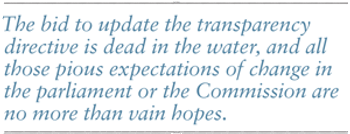
The plan to accelerate generic pricing and reimbursement has become another tragic European casualty.

The possibility of a future "Brexit" - a British exit from the EU - has been exercising the world of medicines, writes Peter O'Donnell.

Brazil is the first Latin American country to emerge as a global biopharmaceutical collaborator. Hellen Berger reports.

UDG Healthcare Integrates Sales, Marketing and Medical Services Offerings

Reflector looks at the growing pains of the European Medicine Agency (EMA) as it faces the key policy challenges of 2014.
Reflector looks at the growing pains of the European Medicine Agency (EMA) as it faces key policy challenges of 2014.

Millennium Takeda's new president, Anna Protopapas, explains the life choices that brought her from Cyprus to Cambridge-and a lead position in the hotly contested search to make cancer a treatable disease.

Can innovation trump ideology? Russia faces a stark choice in betting on the visible hand of government in promoting a "world class" biopharmaceutical sector, writes William Looney.

"Science powers commerce," Canadian Prime Minister Stephen Harper remarked in 2010. In those three words, the Prime Minister summarizes a massive effort by various stakeholders to create a "brain gain" in Canada to strengthen its positioning in the world of research and technology. Despite declining investments by big pharma in recent years, the country has created a number of innovative ways to incentivize R&D and leverage its geographic reach in the North American Market.
Despite the long-held promise of the emerging markets, dominance in these territories has eluded Big Pharma. Hussain Mooraj addresses the key issues and offers a strategy for success.
New regulation offers drug options for patients with rare, severe, or debilitating illnesses.
The past three years have been some of the most eventful in memory for Taiwan's life sciences industry. At this year's Bio Taiwan exhibition, the annual conference that invites the international life sciences community to the island, the excitement was palpable. Foreign companies turned out in record numbers to a keynote address from President Ma Ying-Jeou, who acknowledged that Taiwan was a latecomer to the sector, but nonetheless had the capability and will to compete. Buoyed by a successful wave of financing, good product strategy, and increasing international penetration, the industry seems confident.

Rumor has it the BRIC palace is crumbling. Perhaps that's overdramatic, but at the very least the BRIC oven is cooling off. Where to now? The United States and Europe remain in a state of languid stagnation, while Asia and Africa are largely addressing basic healthcare needs with low-cost generic medicine.
Europe follows the United States with a harsh new spotlight on agreements that slow generic entry for medicines losing exclusivity.