
Pharmaceutical Executive
A crush of Phase III failures triggered an R&D turnaround at AstraZeneca
Pharmaceutical Executive
A crush of Phase III failures triggered an R&D turnaround at AstraZeneca


TKTKTKTKTKTK
Abbott Laboratories has received a positive opinion recommending approval of Humira (adalimumab) for the treatment of moderate to severe plaque psoriasis.
At the recent eyeforpharma Marketing ROI conference in Barcelona, one thing struck me forcefully: just how far behind the times the pharma industry is lagging.

Pharmaceutical Executive
Safety Risks, Generic Threat Scale Down Big Hopes
Pharmaceutical Executive
Bright Spots Are Emerging Markets, Specialty Drugs, Says IMS Health
Pharmaceutical Executive
HHS and Kaiser Family Foundation leverage phone texting technology to help people locate their nearest HIV/AIDS testing facility. Although slow to be adopted by the pharma industry, text marketing is becoming a useful tool to send health information directly to patients.
Pharmaceutical Executive
Pharmaceutical Executive
Cordis, the medical-device arm of J&J, took out full-page ads last week to publicize their drug-eluting stents.
Pharmaceutical Executive
Pfizer named first pharmaceutical sponsor of social-networking community custom tailored for physicians and healthcare providers. Sermo CEO Daniel Palestrant explains how the deal will work.
Pharmaceutical Executive
Novartis forced to cut 1,260 jobs due to dwindling pipeline, Zelnorm withdrawal. The company also adds new pharmaceutical division head.

The oncology market has experienced ten remarkable years. But is the 'Golden Age' coming to an end? IMS Health looks at the changing economics of the cancer industry in Pharm Exec Europe's new e-supplement.
Pharmaceutical Executive
In a blockbuster codevelopment deal, GlaxoSmithKline gains rights to an innovative Phase III melanoma drug.
June 2007 Sworn Statement
PharmRep Direct Promo
Pharmaceutical Executive
New search engine gives consumers the ability to manage all their health needs from a central location--and offers pharma the opportunity to reach new patients through targeted search ads
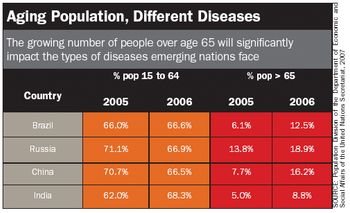
Pharmaceutical Executive
The first wealth is health, wrote American thinker Ralph Waldo Emerson. Indeed, history has taught us (even before Emerson) that health and wealth are inextricably linked-the more money one has, the healthier one is likely to be.

Pharmaceutical Executive
There has been a lot of good news about the Medicare drug benefit in recent weeks. Surveys show a substantial increase in coverage, particularly among low-income seniors. Costs are less than expected; employers continue to offer retiree benefits; major insurers are sticking with the program; and product coverage remains fairly broad. Beneficiaries seem generally satisfied with the program, and the much-feared "doughnut hole" appears less lethal than anticipated (see "A Narrow Gap").

Pharmaceutical Executive
As I work with pharma companies, I'm often asked "When will we get major reform of the healthcare system?" and "What will the reformed system look like?" And sometimes "How will we get there?" This is not the same as asking "How should we reform the system?" Or "What should a reformed system look like?"