
Feature|Videos|November 16, 2026
Keeping Human Expertise at the Center of AI
Key Takeaways
- Identify how to map work along a continuum from pure intelligence tasks to judgment- and empathy-driven tasks to determine where AI should lead, assist, or step back.
- Learn how to maintain a human-at-the-helm role across all categories of work.
Experts explore where artificial intelligence (AI) should take the lead and which decisions should never leave human hands.
Advertisement
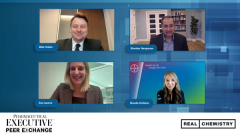
As routine execution becomes increasingly automated, healthcare commercial leaders must decide where AI adds the most value and where human judgment remains essential. In this Peer Exchange® episode, Shankar Narayanan, CEO of Real Chemistry, and Zoë Lazarre, CMO of Genetech, discuss how the human-AI continuum impacts marketers and their agency partners.
Narayanan describes the continuum as a spectrum, with raw intelligence on one end and judgment and empathy on the other. He estimates that roughly 20% of today’s work will become almost entirely AI-driven with light oversight; another 20%, such as rallying a team during a crisis, will remain almost entirely human-led. The 50% to 60% in between depends on strong collaboration and handoffs between people and AI. Given the industry’s compliance requirements, he emphasizes that a human-at-the-helm role remains crucial across every category.
Lazarre adds that the future is not human or AI, but a more intentional choice about what to ask of each. AI can analyze data, identify patterns, optimize media, and generate content, while humans must continue to create meaning. A decision she would not delegate to AI: considering who is not represented in the data, a question central to avoiding a growing digital divide in areas such as rural health. For leaders, she notes, the most valuable workforce skill is not knowing the most about AI but knowing what to delegate to it and what never to delegate.
Advertisement
Related to this article

Sustainable competitive advantage requires combining proprietary evidence, AI, and human expertise—not substituting one for another.
Ossium Health’s Kevin Caldwell joins The Ron Lanton Report to explain how banked, deceased-donor marrow is replacing a months-long search for a living donor with a product hospitals can order on demand.
Pharma field forces face three key challenges: scaling services beyond tier one, shifting from reactive to proactive engagement, and empowering teams with agentic AI.

FDA reportedly shelves its Commissioner’s National Priority Voucher program, Eli Lilly breaks ground on a $3.5 billion Pennsylvania manufacturing site for next-generation obesity treatments, and Parexel’s Stacy Hurt on how small protocol decisions can become enrollment and retention barriers.
FDA Commissioner’s National Priority Voucher program reportedly in limbo for expedited drug reviews.

Eli Lilly breaks ground on a $3.5 billion manufacturing facility in Pennsylvania to produce next-generation obesity treatments like retatrutide.
Every protocol decision affects patients, and only those with lived disease experience can identify true burden — from invasive biopsies to daily trial demands.
Moderna lays out an oncology-driven growth plan at its 2026 Analyst Day, Pfizer and Blackstone sign a co-funding deal worth up to $1.5 billion for berobenatide, and Parexel’s Stacy Hurt on how patients’ use of AI is reshaping sponsor communication.
Advertisement
Advertisement
Trending on PharmExec
1
Eli Lilly Breaks Ground on $3.5 billion Pennsylvania Manufacturing Site
2
When Small Protocol Decisions Become Enrollment or Retention Barriers
3
Pharmaceutical Executive Daily: FDA Shelves CNPV Program
4
The Hidden Risk in Pharma’s AI Rush
5