PaxSafe's Mark Talens on why pharma supply chain AI fails before it starts — and the data foundry framework that changes that.
Anders Romare, Advisory Board Member, causaLens, and former Novo Nordisk CDIO, outlines why artificial intelligence represents a structural turning point for the pharmaceutical industry.
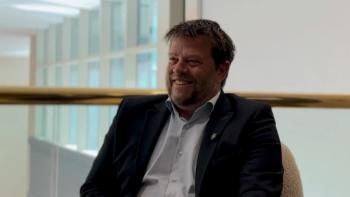
Drawing on decades at the center of global pharmaceutical strategy and innovation, former Novo Nordisk Chief Digital Information Officer and current Advisory Board Member at causaLens Anders Romare discusses a decisive inflection point for both pharma and artificial intelligence. In a conversation with Pharmaceutical Executive, Romare traces his transition from leading large-scale digital transformation inside one of the world’s most sophisticated drugmakers to focusing squarely on AI-driven innovation, arguing that the technology’s true impact will be determined less by algorithms than by data, infrastructure, culture, and regulatory alignment. From drug discovery and clinical development to productivity and patient access, Romare offers a candid assessment of where AI is already reshaping the industry and where structural and organizational realities continue to slow its promise.
A transcript of Romare’s conversation with Pharmaceutical Executive can be found below.
Pharmaceutical Executive: Can you please introduce yourself?
Anders Romare: Yes, so my name is Anders Romar, I'm actually the former chief digital and information Officer of Novo Nordisk and after more than seven years in the company as the CDIO I stepped down and retired at causaLens.
PE: You’ve spent decades shaping the strategic and scientific arc of global pharma. What compelled you to leave that world for AI, and why does now feel like the moment to make that leap into AI-driven innovation at causaLens?
Romare: I think there's many things contributing to that, as you said, I spent a lot of time in pharma at Novo Nordisk, and I was driving a few things in that role. At first, I globalized the organization, built up an organization, but then I was driving the digitalization of Novo Nordisk. A lot of excitement, of course, a lot of dialogs with the executive team, with the board of directors. Then came the AI, and that even further accelerated the whole journey with digital data.
I must say, I'm super excited about AI, but I think there comes a phase, when you need to hand it over to the next generation. I had been driving digitization for seven years and you have to take a choice, whether you're going to drive it for another five years or not. So, I came together with the company to the conclusion it was time to do something else. And I'm really looking forward to next phase, where I hope to be able to still contribute to industry. I call myself semi-retired, but I plan to do things on other side, and AI is maybe the topic that I'm most excited about.
The last presentation I gave to the board at Novo Nordisk roughly a year ago, I really gave the picture that AI is going to have a fundamental impact on not only pharma, but on the society at large. So, I'm a strong believer in AI, and I’m quite happy and quite excited about continuing my sort of professional journey in the field of AI specifically. I can see it in many of the small assignments and many of the small dialogs I have had with various companies around the globe and in fact, AI is at the forefront, so I'm super excited. I'm a strong believer in AI having an impact in the industry.
PE: From your vantage point, what fundamental shifts do you expect to define the next era of pharmaceutical development and how big of an advantage will AI be in steering those changes?
Romare: I think any company can take it broadly, if you like of course, with the productivity gains in all industries. You can read reports from any consultancy company claiming 20%, 25%, 30%, and even 50% productivity gain when you go to software development and that goes across industries, and that that in itself, is good enough to justify a lot of investments and a lot of excitement, But I think in pharma, you have a couple of things that makes it so maybe two or three things make it a bit more specific.
First of all, you have a very long lead time between drug discovery and actually reaching the patient, and on top of that, the probability of success is quite low. So that gives you a lot of incentives to try to shorten that cycle time and of course increase the likelihood of success. For me, you can sometimes hear that people or even colleagues in the industry testify that my relative or my friend actually passed away, and I did know that a potential sort of drug candidate was in the clinical pipeline, and if that would have been more quickly advanced to the patient, that could potentially have saved that person's life. So yes, so for, pharma, we do save people's life and of course, the faster you can get to the to the patient, So I think that's where you have actually a lot of potential in AI. Sometimes people even suggest that you can combine it maybe with quantum computing, but that's another wave of technology that will come eventually, but I think it's clear that we started to already to see the impact.
We can also see the potential to identify new potential sort of drug classes, molecule classes, perhaps not the final molecule per say, but we can start zooming in on those and combine machine learning AI with high-speed throughput robots in the wet lab, and then feed that back into Silico. That really can advance new potential drugs, and I've seen it in other pharma companies, as I don't think Novo Nordisk is unique, but we had some level of success.
I believe the next challenge is maybe the clinical trial phase, which is very time consuming for good reasons, and if you could find a way to get it most likely with regulatory bodies that need to maybe accept another way of measuring and simulating the output, then you can also shorten that timeframe. With AI you can do a lot of smart things in the clinical development phase by crunching the data, writing the reports faster, and so on and so forth, but if you really would like to be radically different in the clinical phase, then you need to do it different with the regulatory bodies. So, I think in that drug discovery phase that can take anywhere between almost 10 to even 15 years and there's huge potential with benefits for patients, for society, and of course companies involved.
If we can zoom in on individual patients and support individual patients in a better way with the help of data and AI, I think that will have a huge impact in the pharma industry, but AI and the data that is now being generated is going to allow us to be more precise and create precision medicine for patients. The drug discovery process, the approach to providing access to the patient, and then general productivity, I think are going to have huge potential impacts in pharma industry, for sure. I think we're going to see new drugs discovered through a good portion of AI in the near future and that's my personal belief.
PE: Pharma has been experimenting with AI for years, but adoption remains uneven. Where do you see companies adapting their operating models, and where are they still missing the mark?
Romare: AI and machine learning has been around for a few years and the thing that really kick started it again, you can say was Gen AI. What happened in pharma at Novo Nordisk where I oversaw it more directly we basically exploded. We had, Open AI, ChatGPT, and similar sort of LLM’s installed quickly and internalized, and people started to use them. We saw a tremendous sort of interest and impact, and a lot of people were asking for those tools and then the company more structurally reacted.
We did a scan across all the whole value chain in Novo Nordisk, from earlier in drug discovery, to patient access, and as part of that journey we came up with a number of use cases. They were around 60 use cases, which is a lot, so we started to take advantage of this and after a little while we understood that maybe this is not the smartest way as we cannot spread ourselves too thin, and maybe the technology is not yet ready.
Speaking to colleagues in pharma and CEO colleagues, many companies are now more specific when trying to find the use cases which really makes a difference, but I think that can vary a little depending on the type of pharma company. So, to take it to the full impact, you also need regulatory approval, and I think that's where the limitations are for AI. We have started to understand where AI is applicable right now and also which areas we still need to work on.
PE: Looking back at your tenure at Novo Nordisk, how did that experience shape your view of the data, infrastructure, and cultural realities required for AI to move the needle inside a large enterprise?
Romare: I think it's a key question, and it's actually one of the key messages we had internally all the way up to the to the board. I mean, you can get really excited about the technology, I’ve met many of the people looking into the future at companies I visited such as MIT, and you sure can get excited.
But when you work in a company, in a large company, perhaps in particular, there's so many more things that you need to worry about. You feel the data, the infrastructure, the processes, the people, the culture, and then finally, the fifth element is the language models or LLM’s.
When I put my plan together and I spoke to my colleagues in leadership, I said, don't worry too much about the models, since we can normally get access to them by buying them or sourcing them from Open AI and other companies in the world, but the data, the infrastructure, and the people, we need to build that ourselves. We focused a lot on data, building more of an enterprise-wide backbone marketplace for data, trying to unlock the data, get governance of data in place, and then upskill the people and the culture. This is a journey we started five years ago, because we spoke about digital and end data, but when we came into this AI push it only accelerated the need of data. Focusing on the infrastructure, getting the data to flow in the company, and the people in the company, that's really the key I would say.