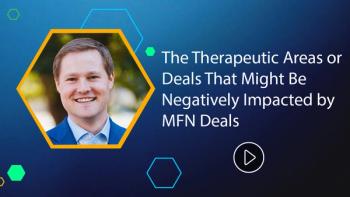
Incubate’s John Stanford on why MFN’s first casualty is the moonshot — and why cancer, Alzheimer’s, and rare disease bear the cost.
Vera Pomerantseva, Director of Product Management for RBQM, eClinical Solutions, touched on AI's growing role in clinical development appearing to be part of a broader effort to strengthen trial evidence.
In a conversation with Pharmaceutical Executive,Vera Pomerantseva, Director of Product Management for RBQM, eClinical Solutions, discusses the FDA's shift to a single pivotal trial for drug approvals. Pomerantseva explains that this change aims to provide stronger evidence of efficacy and patient safety, emphasizing the importance of risk-based approaches and AI in trial design and monitoring. She highlights eClinical's platform capabilities, including customizable centralized monitoring strategies and robust oversight across trial portfolios, to enhance efficiency and ensure regulatory compliance.
A transcript of Pomerantseva’s conversation with Pharmaceutical Executive can be found below.
Pharmaceutical Executive: Where do you see AI having the most transformative impact on how sponsors build, monitor, and defend evidence?
Vera Pomerantseva: In my opinion, AI is so powerful, but again, it's still evolving that it can be used pretty much almost across all of the dimensions in the R&D space and risk management specifically.
So thinking about that process end to end, you want to strengthen scientific evidence, so when you come to the point when you're designing the trial, especially when you have one shot, now you want to come prepared. You may use AI, and AI is perfect for processing big volumes of the information within a fraction of second and suggests and observes some correlations which may help the scientist to translate into the study design or the statistical approach, maybe select the right patient population for that specific study, for that specific indication.
So that would give big efficiency at the start of the study, and as we move forward, AI can be used across the whole execution of the study, suggesting what might be the potential risks, or what might what you have to draw your attention to.
Also in the centralized monitoring world, it's not just indicator by indicator, right? We central monitors spend lot of time conducting root cause analysis, so what's behind it? It's hours and hours, weeks and weeks. So that's what AI can help us with, process, establish correlation, have the suggestions. We still want to have a human in the loop, because of critical thinking.
There are lots of gray areas, and creativity that's what we carry, and AI just can make us more efficient.