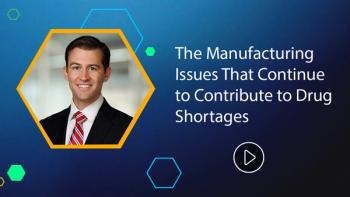
Fox Rothschild's Marc Wagner on why scaling drug production is so slow — overseas API sourcing, supplier qualification, and FDA site approvals that take years.
Fox Rothschild's Marc Wagner on how 503A pharmacies and 503B outsourcing facilities fill drug supply gaps — from COVID injectables to GLP-1s.
Drug shortages remain a difficult to fix issue for the pharma industry and are an issue that can have devastating results. Often times, shortages hit because of an increased demand for the medication, leaving patients waiting for gaps in the supply chain to be filled.
Pharmaceutical Executive spoke with Marc Wagner, an FDA and life sciences attorney at Fox Rothschild, about the manufacturing and regulatory pressures that contribute to drug shortages. According to him, these shortages happen for a variety of reasons and there is single fix.
Instead, there are multiple steps the industry must take to prepare for increases in demand and pipeline disruptions. A major issue is the industry’s dependence on overseas production, which leaves the supply open to global pressures. According to Wagner, a majority of generic drug products are manufactured outside of the US, meaning that these sites may not be unable to pick the slack.
Pharmaceutical Executive: What role can 503B outsourcing and compounding pharmacies actually play in filling supply gaps?
Marc Wagner: State-licensed pharmacies compounding under Section 503A of the Federal Food, Drug, and Cosmetic Act, and 503B outsourcing facilities registered with the FDA, both play critical roles in helping to mitigate drug shortages. Neither type of compounding entity is a silver bullet — they cannot solve every drug shortage — but there is a meaningful role in the drug supply chain where these facilities can step in, provide gap supply, and help mitigate shortages for products on FDA's drug shortage list.
As a pharmacist by training, I have a natural affinity for compounding pharmacies and outsourcing facilities. And both Congress and the FDA have recognized these facilities in legislation, giving them the ability to compound drug products when those products appear on the drug shortage list.
Section 503A state-licensed pharmacies are permitted to compound what the FDA calls "essentially a copy" of a commercially available product — meaning they can compound the same drug a conventional manufacturer produces if that manufacturer's product is not commercially available.
Section 503B outsourcing facilities operate similarly. They are permitted to compound from bulk drug substance — active pharmaceutical ingredient — and can produce an exact copy of an FDA-approved product when that product is on the FDA drug shortage list. Congress has explicitly recognized 503B outsourcing facilities as an important tool for mitigating drug shortages.
We have seen both compounding pharmacies and outsourcing facilities step up during major shortage events. During the COVID-19 pandemic, they played an important role filling gaps in sterile injectable products used in hospital settings that were on the shortage list. More recently, both types of facilities stepped in to help address the GLP-1 shortages that emerged around 2022 and 2023. Both remain available and positioned to respond as new shortages arise.