
All News
Advertisement
Advertisement
Pharmaceutical Executive
Safety Risks, Generic Threat Scale Down Big Hopes
Pharmaceutical Executive
Bright Spots Are Emerging Markets, Specialty Drugs, Says IMS Health
Pharmaceutical Executive
HHS and Kaiser Family Foundation leverage phone texting technology to help people locate their nearest HIV/AIDS testing facility. Although slow to be adopted by the pharma industry, text marketing is becoming a useful tool to send health information directly to patients.
Pharmaceutical Executive
Advertisement
Pharmaceutical Executive
Cordis, the medical-device arm of J&J, took out full-page ads last week to publicize their drug-eluting stents.
Pharmaceutical Executive
Pfizer named first pharmaceutical sponsor of social-networking community custom tailored for physicians and healthcare providers. Sermo CEO Daniel Palestrant explains how the deal will work.
Pharmaceutical Executive
Novartis forced to cut 1,260 jobs due to dwindling pipeline, Zelnorm withdrawal. The company also adds new pharmaceutical division head.

The oncology market has experienced ten remarkable years. But is the 'Golden Age' coming to an end? IMS Health looks at the changing economics of the cancer industry in Pharm Exec Europe's new e-supplement.
Advertisement
Pharmaceutical Executive
In a blockbuster codevelopment deal, GlaxoSmithKline gains rights to an innovative Phase III melanoma drug.
June 2007 Sworn Statement
PharmRep Direct Promo
Pharmaceutical Executive
New search engine gives consumers the ability to manage all their health needs from a central location--and offers pharma the opportunity to reach new patients through targeted search ads
Pharmaceutical Executive
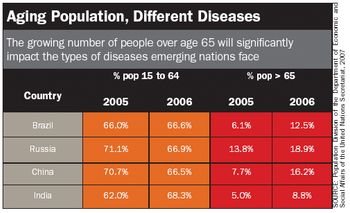
The first wealth is health, wrote American thinker Ralph Waldo Emerson. Indeed, history has taught us (even before Emerson) that health and wealth are inextricably linked-the more money one has, the healthier one is likely to be.

Pharmaceutical Executive
There has been a lot of good news about the Medicare drug benefit in recent weeks. Surveys show a substantial increase in coverage, particularly among low-income seniors. Costs are less than expected; employers continue to offer retiree benefits; major insurers are sticking with the program; and product coverage remains fairly broad. Beneficiaries seem generally satisfied with the program, and the much-feared "doughnut hole" appears less lethal than anticipated (see "A Narrow Gap").

Pharmaceutical Executive
As I work with pharma companies, I'm often asked "When will we get major reform of the healthcare system?" and "What will the reformed system look like?" And sometimes "How will we get there?" This is not the same as asking "How should we reform the system?" Or "What should a reformed system look like?"
Postle fig 6
Postle fig 3
The pace of change
Postle fig 1
Postle fig 5

Pharmaceutical Executive
Search engine giant says industry lags behind on e-marketing
Pharmaceutical Executive
Pfizer computers infiltrated by spammers
Pharmaceutical Executive
Two Internet superpowers are invading online consumer-health territory. What does it mean for pharma?
PharmExec November Advertiser Impact Study sellsheet

Pharmaceutical Executive
As expected, must-pass legislation to reauthorize the Prescription Drug User Fee Act (PDUFA IV) has provided a vehicle to renew numerous programs and to establish new policies to ensure the safe use of medications. The measure implements a user-fee agreement issued in January 2007 as well as a similar user-fee plan for medical devices. It also continues incentives for sponsors to study pediatric uses of drugs and devices and gives FDA authority to require postapproval studies. Manufacturers will have to disclose more information about ongoing clinical trials and research results and must revise product labels within a set time frame. There is more funding for FDA oversight of postmarket drug use and for agency information systems. And manufacturers of more risky medications will have to adopt a range of pharmacovigilance activities to ensure appropriate product use.

Pharmaceutical Executive
In this issue, a longtime contributor to this magazine, former FDA official, and generally thoughtful, knowledgeable person concludes his excellent three-part series on drug safety with a look at how risk is communicated to patients and doctors. It's a fine, detailed, subtle piece of work, and I recommend it to you. (See "Failure to Communicate".)
Pharmaceutical Executive
New marketing agency helps pharma companies clean up their act
Advertisement
Advertisement
Trending on PharmExec
1
How Exposed is The U.S. Pharmaceutical Supply Chain to China’s Updated Export Control Regulations?
2
Bristol Myers Squibb Expands Collaboration with Nvidia to Build AI Factory
3
Pharmaceutical Executive Daily: Bristol Myers Squibb Expands Partnership with Nvidia
4
Staying Ahead of Viral Evolution: Q&A with Robert Allen, Ph.D
5