
All News
Advertisement

Pharmaceutical Executive
One of pharma's thorniest challenges is how to optimize the potential value of its R&D portfolio with limited resources. To address that, many pharma and biotech companies have begun to enhance their capabilities in the new discipline of portfolio project resource management (PPRM).
Advertisement

Pharmaceutical Executive
Many hospitalized patients, confronted with an immediate health threat and looking for ways to pass the time between visting hours, are prime candidates for health messages delivered through a unique medium: direct-to-patient (DTP) television networks. But there's a catch. Although such networks give pharma an excellent opportunity to reach a highly motivated audience with disease and treatment education and product promotion, the hospital-based DTP market is as risky as it is attractive.
Pharmaceutical Executive
Not long ago the average pharma development organization spent $100 to $200 million a year. It consisted of about 100 people working on only a half dozen compounds. Its leaders typically knew all their employees by name. There was a good deal of visibility within the organization: Managers could see from top to bottom and could make decisions aided by nothing but their own brains.
Pharmaceutical Executive
The next five years will determine whether pharma retains its position as the most profitable major industry. It will do so only if it succeeds in justifying its profit margins and the high prices that US consumers pay for its products. That will be tough. When Adlai Stevenson was running for president, an enthusiastic supporter gushed, "Oh, Mr. Stevenson, you will win the thinking man's vote.

Pharmaceutical Executive
Thanks to growth in international trade, rapid technological innovation, and a willingness to share intellectual property (IP), the number of corporate cross border alliances has grown steadily.
Advertisement
Pharmaceutical Executive
In his new book, former Lilly CEO Randall Tobias explains his ideas about management. Do they work? He'll have a chance to prove it as he takes the reins of America's $15 billion global campaign against AIDS.
Pharmaceutical Executive
The economy may still be suffering from the twin shocks of September 11th and a bursting technology bubble, but pharma spending on promotions continues to grow at a double-digit pace.
Advertisement
Pharmaceutical Executive
Pharmaceutical Executive challenges 21 experts to grapple with the future of the healthcare system.

Pharmaceutical Executive
I suppose, when you get right down to it, I've gotten used to the idea that in this country we don't actually debate issues. We holler and call our political enemies names. We play elaborate games of spin control and do our damnedest to ensure that every question of policy, no matter how straightforward and practical, gets linked in the public mind with abortion rights, gun control, and a half dozen other completely intractable hot-button issues.
Pharmaceutical Executive
Affordable healthcare has become a leading political and social hot button in the United States, and managed care organizations (MCOs) have responded by seeking to reduce pharmaceutical expenses to rein in rapidly increasing costs.

Pharmaceutical Executive
When I was a kid, I remember reading magazine articles that set out to determine the worth of the human body-not its personal value, or its ability to produce valuable labor, but just the market value of the chemicals that composed it. The figure I remember hearing was $1.98. Pocket change for the crown of creation.
Pharmaceutical Executive
Before Botox became a popular beauty treatment, Allergan was just a small ophthalmic business that made prescription eye therapies and contact lens care products.
Pharmaceutical Executive
Innovative products, and the research and development teams that produce them, are pharma's life blood. So it's no surprise that, according to PE's 2003 Top 50 Pharma, the largest 20 pharma companies alone spent $45.5 billion on R&D.
Pharmaceutical Executive
Now that patents on several blockbuster drugs have expired, the industry-feeling the pinch-has focused its attention on intellectual property. Because every additional month of market exclusivity can mean an extra $50 million or more in revenue, pharma companies have gone to great lengths to block the entry of generic competition.
EPE Media Kit - Marketing Services
EPE Media Kit - Magazine
EPE Media Kit - Editorial
Pharmaceutical Executive
Thanks to managed care's efforts to steer patients into the least intensive treatment settings, primary care practitioners (PCPs) play an increasingly important role in prescribing.

Pharmaceutical Executive
How should drug companies and physicians interact? And if something is wrong with the relationship, who's to blame?
Pharmaceutical Executive
Pharma companies seem to have forgotten one key lesson: Blockbusters are made, not discovered. Few drugs achieve top sales based on their initial formulation and indications.
Pharmaceutical Executive
Partnerships between pharmaceutical (Rx) and diagnostic (Dx) companies are difficult to achieve because most managers don't understand what it takes to make them work.
Pharmaceutical Executive
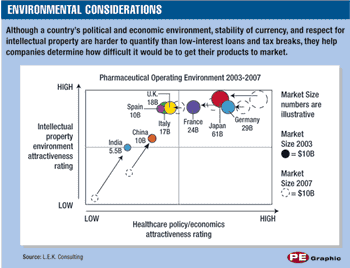
Point a finger at a map of the United States and try to find a state that's not competing to attract pharma and biotech business. It's nearly impossible. The story is the same in Europe and Asia. Around the world, countries, regions, and cities are trying to build their economies, and the life sciences are a key element in their plans.
Pharmaceutical Executive
Pfizer Chairman and CEO Hank McKinnell sees the company's $58 billion blockbuster acquisition of Pharmacia as the key to Pfizer's leadership in pharmaceutical markets around the globe.
Pharmaceutical Executive
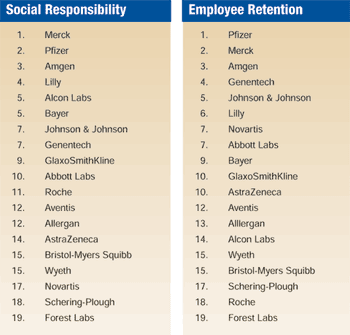
Even among industry insiders, company reputations are hard-earned and subject to change. Rating Research's (RRC) second annual Reputation Strength Study of the Pharmaceutical Industry surveyed financial analysts and industry senior executives to see how 19 companies stack up against each other and to see how their overall reputations changed from last year.
Pharmaceutical Executive
Patient recruitment for clinical trials is one of the most significant bottlenecks in drug development. As a result, several organizations have called for the establishment of recruitment best practices, beginning in 2000 with the Office of the Inspector General's (OIG) report on recruiting human subjects and most recently in a Clinical Research Roundtable report published in the March 12, 2003 issue of the Journal of the American Medical Association (JAMA).
Advertisement
Advertisement
Trending on PharmExec
1
How Exposed is The U.S. Pharmaceutical Supply Chain to China’s Updated Export Control Regulations?
2
Bristol Myers Squibb Expands Collaboration with Nvidia to Build AI Factory
3
Pharmaceutical Executive Daily: Bristol Myers Squibb Expands Partnership with Nvidia
4
Staying Ahead of Viral Evolution: Q&A with Robert Allen, Ph.D
5