Regulatory

Latest News


Pharmaceutical Executive

Often, post-approval marketing studies don't materialize because drug companies question their value. Independent review of the need for such studies would address pharma's concern that they may be warranted.

Pharmaceutical Executive

Serious offenders of the new Association of the British Pharmaceutical Industry's Code of Practice can be "named and shamed" with adverts in the trade press. Details of breaches by companies will be posted online.

Pharmaceutical Executive

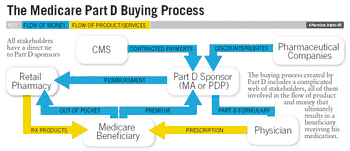
Patient-Program Interface Nearly one-third (2.5 million) of the estimated eight million Americans currently enrolled in PAPs are over age 65 and will be eligible to participate in the government's Part D program.

Pharmaceutical Executive

The public is focused on drug safety, but the real issue isn't approval standards. It's the way drugs expand to unapproved new indications. Are you listening, Acomplia?

Pharmaceutical Executive

Despite heightened scrutiny from industry advocates and the beginnings of self-imposed regulation, pharma companies' violations of DTC regulations have been getting worse, says Tom Abrams, director of FDA's Division of Drug Marketing, Advertising, and Communications (DDMAC). Abrams has been on all sides of drug marketing, from receiving promotions as a pharmacist to creating promotions as a member of industry to regulating promotions as the head of DDMAC. As such, he's in good position to see the big picture.


Pharmaceutical Executive

Genentech and Biogen's MabThera has been awaiting NICE appraisal for three years. Merck KGaA's Erbitux has waited two-and-a-half years. A ruling on AstraZeneca's Arimidex isn't expected for more than a year.

Pharmaceutical Executive

In an opinion piece in the September 8 New England Journal of Medicine, Harvard medical professor and long-time industry critic Jerry Avorn takes a whack at FDA, accusing the agency of practicing a level of science that wouldn’t pass muster anywhere else in research-science that’s only "good enough for government work.";

Pharmaceutical Executive

Think of the role compliance plays in your job. Now imagine that level of concern increased by 25 percent, 50, or even more. That's what pharma has to look forward to in the next few years, as the effects of old regulatory initiatives, such as 21 CFR Part 11 and Sarbanes Oxley, start fully kicking in-and as we experience the as-yet-unknown regulatory fallout of the new concern with drug safety. It's no surprise that a great portion of this volume of Pharm Exec's Successful Product Manager's Handbook series is given over to compliance.

Pharmaceutical Executive

UK courts are affirming the belief that medical research and drug development have made a huge contribution to people's quality of life, and that a small but vital part of that work involves the use of animals.

Pharmaceutical Executive

The pharmaceutical industry devotes more of its promotional budget to samples than anything else, unless you count the army of sales representatives that delivers them. This year, the average wholesale price of samples passed out to doctors will approach $15 billion-roughly twice the value of samples five years ago. And although few in the industry have come to grips with it, the federal regulations governing this enormous investment have undergone drastic changes.

Global Report: Kids 'R' EU

Pharmaceutical Executive

If the legislation passes, companies will be rewarded with a six-month extension of market exclusivity if they conduct pediatric trials. And under the proposal, companies that fail to comply can be penalized.

Pharmaceutical Executive

Class actions threaten industries that deal with the public. If European lawmakers remove the restriction on class-action suits, consumers will be free to file cases. Pharma companies should take heed.

Pharmaceutical Executive

My doctor and I have two different visions of an avian influenza pandemic. She's picturing regular flu season, but worse. I'm imagining 1918. Does the conflict sound familiar?

i1-175697-1408686165109.jpg

Pharmaceutical Executive

SPCs extend a drug's basic patent protection for up to five years, to take into account the time that may have lapsed between the filing of a patent application and the granting of market authorization.

i2-175698-1408686160374.gif

Pharmaceutical Executive

Manufacturers will have to incorporate Part D–specific messaging into all of their current marketing materials. In addition, they should consider publication plans and CME that specifically address the needs of seniors.