


Pharmaceutical Executive
Many still regard FDA's approach as costly and unnecessary. But the prospect of qualifying for purchase by PEPFAR is attracting applicants. The policy has helped bring news AIDS treatments to market.

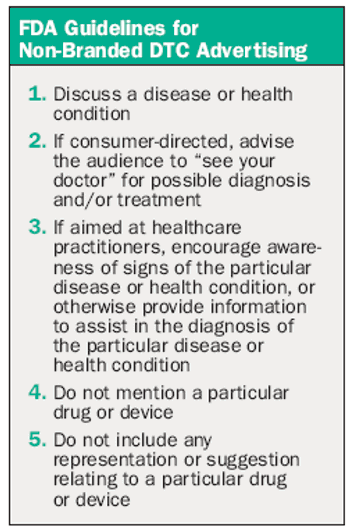
Despite heightened scrutiny from industry advocates and the beginnings of self-imposed regulation, pharma companies' violations of DTC regulations have been getting worse, says Tom Abrams, director of FDA's Division of Drug Marketing, Advertising, and Communications (DDMAC). Abrams has been on all sides of drug marketing, from receiving promotions as a pharmacist to creating promotions as a member of industry to regulating promotions as the head of DDMAC. As such, he's in good position to see the big picture.

Pharmaceutical Executive
Many still regard FDA's approach as costly and unnecessary. But the prospect of qualifying for purchase by PEPFAR is attracting applicants. The policy has helped bring news AIDS treatments to market.

Pharmaceutical Executive
Think of the role compliance plays in your job. Now imagine that level of concern increased by 25 percent, 50, or even more. That's what pharma has to look forward to in the next few years, as the effects of old regulatory initiatives, such as 21 CFR Part 11 and Sarbanes Oxley, start fully kicking in-and as we experience the as-yet-unknown regulatory fallout of the new concern with drug safety. It's no surprise that a great portion of this volume of Pharm Exec's Successful Product Manager's Handbook series is given over to compliance.

Pharmaceutical Executive
Product managers would be less disrupted if compliance activities at pharma companies were more anticipatory than reactionary.

Pharmaceutical Executive
UK courts are affirming the belief that medical research and drug development have made a huge contribution to people's quality of life, and that a small but vital part of that work involves the use of animals.

Pharmaceutical Executive
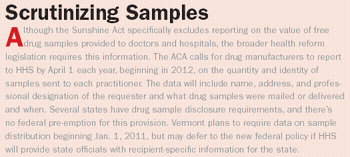
The pharmaceutical industry devotes more of its promotional budget to samples than anything else, unless you count the army of sales representatives that delivers them. This year, the average wholesale price of samples passed out to doctors will approach $15 billion-roughly twice the value of samples five years ago. And although few in the industry have come to grips with it, the federal regulations governing this enormous investment have undergone drastic changes.

Pharmaceutical Executive
FDA could lose 251 employees under the administration's proposed 2006 budget. The agency will try to do more with less through risk-management practices, but important tasks will fall by the wayside.

Pharmaceutical Executive
If the legislation passes, companies will be rewarded with a six-month extension of market exclusivity if they conduct pediatric trials. And under the proposal, companies that fail to comply can be penalized.

Pharmaceutical Executive
Class actions threaten industries that deal with the public. If European lawmakers remove the restriction on class-action suits, consumers will be free to file cases. Pharma companies should take heed.

Pharmaceutical Executive
My doctor and I have two different visions of an avian influenza pandemic. She's picturing regular flu season, but worse. I'm imagining 1918. Does the conflict sound familiar?

Pharmaceutical Executive
Integra v. Merck KGaA supports research by large pharmaceutical companies, but it also opens the door to greater use of compounded materials by all parties. Congress may have to clarify its scope.

Pharmaceutical Executive
SPCs extend a drug's basic patent protection for up to five years, to take into account the time that may have lapsed between the filing of a patent application and the granting of market authorization.

Pharmaceutical Executive
Manufacturers will have to incorporate Part D–specific messaging into all of their current marketing materials. In addition, they should consider publication plans and CME that specifically address the needs of seniors.

Pharmaceutical Executive
If congressmen gathered to work through the nuances of banning ED drugs from reimbursement under Medicare, they'd still back the ban. But the decision would be grounded in lack of faith in prescribing behavior, not disregard for a debilitating condition.

Pharmaceutical Executive
The cost of healthcare has become so great that it's important to review the evidence to determine whether the drug is a good value for the money. Yet, pharmacoeconomics is rarely included in the decision process.

Pharmaceutical Executive
If congressmen gathered to work through the nuances of banning ED drugs from reimbursement under Medicare, they'd still back the ban. But the decision would be grounded in lack of faith in prescribing behavior, not disregard for a debilitating condition.

Pharmaceutical Executive
Procter & Gamble Pharmaceuticals discovered that a network resulting from even a modest integration offered benefits that exceeded the sum of its parts.

Pharmaceutical Executive
For pharma companies large and small, one of the most pressing challenges of the next few years will be to understand compliance at a much deeper level, to obtain the tools to make it possible.

Pharmaceutical Executive
Pilot projects involving RFID technology are appearing at some major pharma companies. But uptake of RFID-based solutions remains limited due to concerns about accuracy, reliability, and ROI.

Pharmaceutical Executive
Traders say parallel distribution of drugs generates savings for patients. Industry says it creates more profits for traders, leaving pharma with less R&D funding.

Pharmaceutical Executive
State clinical trials requirements are in place to protect people from being exploited, or unsafely exposed to compounds. Forty years later, it's easy to say, "How did this happen?"

Pharmaceutical Executive
All too often, abuse liability and dependence potential are afterthoughts in the drug development process.

Pharmaceutical Executive
A prolonged QT interval creates an electro-physiological environment that is favorable for the development of cardiac arrhythmias.

Pharmaceutical Executive
CMS envisions studies to show which drugs keep patients out of hospitals or how certain treatments can reduce side effects. Such analysis would support decisions on best practices in using medications.

Pharmaceutical Executive
When Jim Dougherty joined Mcgraw-Hill almost 30 years ago, medical journal publishing was just plain different than it is today. The days of the "three-martini lunch" were slowly coming to an end. Yet many companies still determined their ad schedules based on relationships. There was also less competition: without DTC or the Internet, journals garnered larger percentages of pharma's marketing mix. Today, Dougherty is group vice president of McGraw-Hill Healthcare Information and president of the Association of Medical Publications (AMP), an organization of publishing firms in the medical field. Like many of his peers, Dougherty has witnessed-and continues to witness-the transformation of the field. The future is bright, he says, but most certainly uncertain.

Pharmaceutical Executive
Pharma execs and industry analysts say pharma's reputation has improved during the past year. The general public sees things differently. Research says a few select companies are to blame.