
Pharmaceutical Executive
Soon people will remember animated ad banners and the measurement of their click-through rates as merely the first generation of online marketing.
Pharmaceutical Executive
Soon people will remember animated ad banners and the measurement of their click-through rates as merely the first generation of online marketing.

Pharmaceutical Executive
The integration and digitization of fragmented data is about to transform pharmaceutical sales and marketing strategies. And physicians are ready to adopt the new business model of an e-prescribing network

Pharmaceutical Executive
Every night at Merck facilities around the world, an automated computer clicks and whirls as it collects proteins and DNA sequences, in an inexorable process that has built a mountainous terabyte of data at four research centers. And that data will double every eight months.

Pharmaceutical Executive
An evolution is underway. As the industry faces new technologies and economic changes, many companies have begun to experiment with the concept of customer centricity, otherwise known as customer relationship management.
Pharmaceutical Executive
Who, or what, creates wealth? Answering that question has become as much political football as economic theory. Last month, the US president reminded us that government does not make wealth but, at best, fosters a climate conducive to it. The old-left idea that workers create and should share equally in the fruits of production has long since died of exhaustion. By process of elimination, the only apparent answer remaining belongs to idealistic capitalists, who herald the enterprising companies from which all wealth "obviously" flows-for most of us, as paychecks.
Pharmaceutical Executive
As savvy product managers know, the pharma industry is in the process of reinventing itself to compete in the new bioeconomy - a global economic framework that will introduce and apply technologies such as genomics and proteomics across multiple industries.

Pharmaceutical Executive
It's time for the big project. Top management in a leading pharma company wants executive A, a rising star in the marketing department, to evaluate a new technology's impact on the industry-and on his company. The technology has the potential to dramatically affect not only pharmaceutical discovery and development but also marketing and sales. But there are many factors to analyze, and no one in his company has the expertise to do it.
Pharmaceutical Executive
Imagine that establishing a marketing budget was simply a matter of someone saying, "Here, take as much as you need." No more give and take over the numbers.

Pharmaceutical Executive
Pfizer's formidable front entrance in the heart of midtown Manhattan hums like no other in the industry. Compared with most pharma company headquarters, this is a train station.

Pharmaceutical Executive
Competition for physicians' time has become so intense that some medical groups have severely restricted or banned reps altogether. Part of that strained relationship can be traced back to some of the sales techniques used by aggressive pharma salespeople. Physicians have become wary of being "sold" and often do not trust the information reps provide. Many doctors no longer feel that sales reps help provide better care for patients. Rather, physicians often come away feeling as though they just had an encounter with a used car dealer. To improve their relationships with medical professionals, pharma sales reps should avoid ten
Pharmaceutical Executive
Geneva-The pharma industry has given a guarded welcome to a World Health Organization report that explicitly links poverty and poor health.
Pharmaceutical Executive
Healthcare costs and health insurance premiums have soared, and analysts point to double-digit hikes in spending on prescription medicines as a prime culprit. A recent annual survey by the Department of Health and Human Services' (HHS) Centers for Medicare and Medicaid Services (CMS) finds that healthcare spending in 2000 increased 7 percent to $1.3 trillion, the biggest increase in the past decade, outpacing gross domestic product growth. Prescription drug expenditures alone jumped 17 percent, making them the fastest growing service expense for that year. The Kaiser Family Foundation (KFF) also reports that the portion of total healthcare spending devoted to
Pharmaceutical Executive
Washington, DC-A new advisory committee appointed by HHS secretary Tommy Thompson will scrutinize agency policies to identify ways to improve programs and regulations.

Pharmaceutical Executive
In a tight market, pharma companies are asking themselves: "How can we get more from scarce resources?" As a result, R&D and sales/marketing expenditures are under increased scrutiny-and they should be. Both areas consume significant resources (about 25 percent of revenues combined) have experienced rapid growth, and their results have been difficult to quantify. But to make the most of both human and non-human assets, management must first understand how those assets are currently allocated, how to make them more productive, and if there are better ways to deploy them. That substantial task will be further exacerbated as the industry
Pharmaceutical Executive
The main challenge for pharma companies this year will be to address public concerns about drug prices and access. Although recent bioterrorism fears raised demands for life-saving medicines, the public focus has shifted to the rise in pharmaceutical expenditures and its effect on healthcare costs and on efforts by insurers and government health agencies to limit pharmaceutical coverage.
Test 2
Pharmaceutical Executive
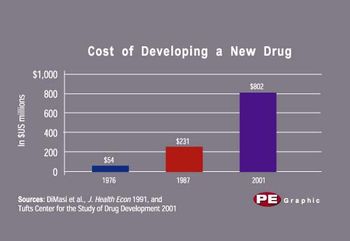
One reason new medicines are more expensive is that the cost of discovering and producing new therapies is soaring.

Pharmaceutical Executive
"You never listen to me."
Pharmaceutical Executive
For once, health activists and the pharma industry both welcomed a World Trade Organization declaration on Trade-Related Aspects of Intellectual Property Rights (TRIPS) and public health, but there is little doubt that it opens the way to further compulsory licensing and parallel imports.

Pharmaceutical Executive
MICHIGAN-In an aggressive move to squeeze price discounts from the industry, Michigan recently released a list of pharmaceuticals, mostly generic and lower-priced,
Pharmaceutical Executive
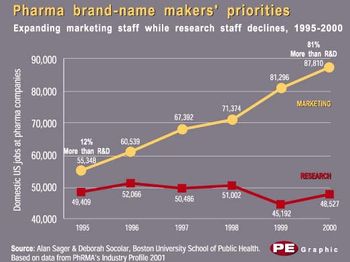
The wrangling over whether pharma companies invest more in R&D than in marketing is heating up again.
Pharmaceutical Executive
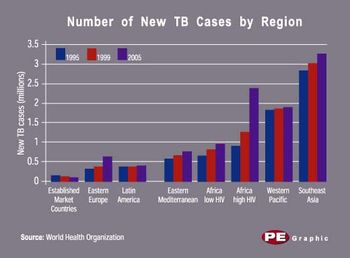
Once thought to be a disease of the past, tuberculosis is now a front burner health problem.

Pharmaceutical Executive
If you support the pharmaceutical industry, you will applaud Alan Holmer and the Pharmaceutical Research and Manufacturers of America he presides over. You might disagree with some of the details. But mud you will not sling, nor buy every critic's case against this protector of the industry.
Pharmaceutical Executive
Washington, DC-With no signs that FDA plans to significantly limit direct-to-consumer advertising of prescription medicines, state governments across the country are proposing their own curbs. During the past year, legislators considered some 60 bills or resolutions concerning pharma marketing or advertising, and efforts are likely to increase as state policy makers link DTC advertising to rising drug expenditures.

Pharmaceutical Executive
No one can pinpoint the precise instant it happened, but the dull cloud of our universe suddenly cleared. About a half-billion years had gone by since the Big Bang, finally giving the condensing proto-stars and quasars enough time to sweep a veil of dust from the young cosmos. Their light then penetrated the darkness and, along with that of countless other spawning suns, has traveled the skies ever since.

Pharmaceutical Executive
Despite the near paralysis resulting from the events of September 11, many businesses that had operated from New York's World Trade Center needed to be up and running the next day.
Pharmaceutical Executive
Geneva, Switzerland-A Medecins sans Frontieres (Doctors without Borders) report claiming there is virtually no research into diseases that predominantly affect the poor is distorted and politically motivated, says Dr. Harvey Bale, director-general of the International Federation of Pharmaceutical Manufacturers Associations (IFPMA). He claims that medicines do exist to treat most of the more dangerous diseases affecting poor people, but in many cases they do not reach patients for reasons that are beyond control of the pharmaceutical industry.
Pharmaceutical Executive
Johannesburg, South Africa-GlaxoSmithKline announced in October that it had licensed Aspen Pharmacare to manufacture three AIDS products: Retrovir-AZT (zidovudine), Epivir-3TC (lamivudine), and Combivir (zidovudine/lamivudine). The products can be distributed only to the public, including the government, non-governmental organizations (NGOs), and charitable bodies accredited by the World Health Organization (WHO).
Pharmaceutical Executive
Washington, DC-More countries are hosting pharma's R&D efforts, creating a research environment ripe for abuses of patient safety because FDA cannot ensure the same protection in foreign trials as in domestic ones. A recent study by the US Health and Human Service's office of the inspector general (OIG) found that regions with less research experience-including Eastern Europe, Latin America, and East Asia-have become more desirable locations for US-based companies and contract research organizations' clinical trials. In fact, the number of countries producing data for FDA submissions jumped from 28 to 79 between 1989 and 1999. And that trend shows no
Pharmaceutical Executive
Tokyo, Japan-European pharma industry leaders have called for the opening of the Japanese market through measures to promote greater innovation there. The demand followed a European Federation of Pharmaceutical Industries and Associations' visit to Japan led by EFPIA president Jean-Frany}ois Dehecq, chairman and CEO of Sanofi-Synthelabo.