All News

Pharmaceutical Executive

Innovative products, and the research and development teams that produce them, are pharma's life blood. So it's no surprise that, according to PE's 2003 Top 50 Pharma, the largest 20 pharma companies alone spent $45.5 billion on R&D.

Pharmaceutical Executive

Now that patents on several blockbuster drugs have expired, the industry-feeling the pinch-has focused its attention on intellectual property. Because every additional month of market exclusivity can mean an extra $50 million or more in revenue, pharma companies have gone to great lengths to block the entry of generic competition.

Pharmaceutical Executive

Thanks to managed care's efforts to steer patients into the least intensive treatment settings, primary care practitioners (PCPs) play an increasingly important role in prescribing.

Pharmaceutical Executive

Pharma companies seem to have forgotten one key lesson: Blockbusters are made, not discovered. Few drugs achieve top sales based on their initial formulation and indications.

chart1-59328-1408717857990.gif

Pharmaceutical Executive

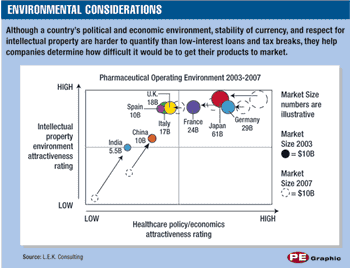
Point a finger at a map of the United States and try to find a state that's not competing to attract pharma and biotech business. It's nearly impossible. The story is the same in Europe and Asia. Around the world, countries, regions, and cities are trying to build their economies, and the life sciences are a key element in their plans.

chart9-59320-1408717876686.gif

Pharmaceutical Executive

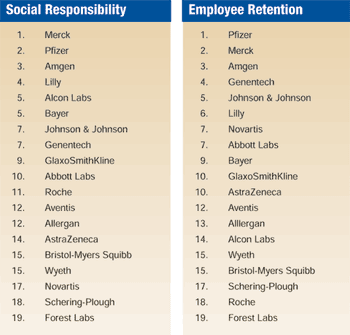
Even among industry insiders, company reputations are hard-earned and subject to change. Rating Research's (RRC) second annual Reputation Strength Study of the Pharmaceutical Industry surveyed financial analysts and industry senior executives to see how 19 companies stack up against each other and to see how their overall reputations changed from last year.

Pharmaceutical Executive

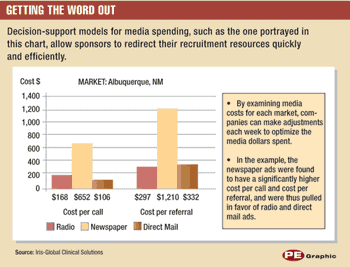
Patient recruitment for clinical trials is one of the most significant bottlenecks in drug development. As a result, several organizations have called for the establishment of recruitment best practices, beginning in 2000 with the Office of the Inspector General's (OIG) report on recruiting human subjects and most recently in a Clinical Research Roundtable report published in the March 12, 2003 issue of the Journal of the American Medical Association (JAMA).

Pharmaceutical Executive

During the next ten years, big pharma companies will need to launch two products a year to generate 5 percent annual growth, five products a year to hit 10 percent growth, and nine products a year to meet a 15 percent annual growth target. Clearly, the stakes are high.

image1-59241-1408717947696.jpg

Pharmaceutical Executive

My train reading this week has been Protecting America's Health, Philip J. Hilts' enlightening history of the Food and Drug Administration. It's a book with a strong sense of how politics, people, and the uncontrollable flow of events conspire to shape institutions. It's also a good read, thanks to the author's fine eye for anecdote. Over and over, Hilts selects just the right story to capture the essence of an era in the agency's history.

Pharmaceutical Executive

A powerful new tool is available to FDA through a first-of-its-kind cooperative research and development agreement (CRADA) between FDA and EduNeering, a developer of computer-based compliance training systems.

Pharmaceutical Executive

Contrary to popular belief, physicians still can't retrieve the full medical history of every patient who walks into their offices. Nor can they zap prescriptions through a clearinghouse that shows whether patients are eligible for coverage and reviews all medications they are taking to forestall drug?drug interactions.

Pharmaceutical Executive

According to many legislators and the media, pharma companies, abetted by Madison Avenue, lead the corporate villain list, just below auditors and errant CEOs.

image1-55201-1408715815211.jpg

Pharmaceutical Executive

In the excellent online magazine The Edge (www.edge.org), Gerd Gigerenzer, director of the Center for Adaptive Behavior and Cognition at the Max Planck Institute for Human Development in Berlin, poses a riddle about risk: Imagine that a 40-year-old woman has her first mammogram and it comes back positive. The incidence of the disease in her age group is 1 percent. The test is 90 percent accurate, and it has a false-positive rate of 9 percent. What's the probability that the woman has cancer?

Advanstar Communications Inc. announced that its Pharmaceutical Executive magazine was awarded, for the second year in a row, the coveted Jesse H. Neal National Business Journalism Award for editorial excellence from the American Business Media (ABM).

Pharmaceutical Executive

The pharmaceutical industry is experiencing unprecedented late-stage setbacks, product recalls, and difficulties in generating high-quality drug candidates. The problems are not specific to any one company or research effort but rather a result of the industry's limited knowledge of biology and chemistry.

chart1-53002-1408718054838.gif

Pharmaceutical Executive

When it comes to recruiting and enrolling individuals in clinical trials, the industry's challenge is similar to the one that General Riggs cites in his call to modernize the US Army.

Pharmaceutical Executive

The trick in understanding any contentious public debate is to figure out what's being left out of the discussion. What, for example, is the assumption that's so obvious that no one thinks to bring it up? More often than not, when you've located that assumption, you've found the secret core of the argument -- the part that everyone's really fighting over and no one can bear to mention.

Pharmaceutical Executive

As scientists' knowledge of biochemical pathways increases, so does the number of patents issued for generic treatment claims. Such claims represent methods of treating disease by modulating a particular protein in the body.