
Pharmaceutical Executive
Hard on the heels of the June 2000 announcement that the human genome sequence was completed came a wide array of articles on genomics' impact on drug discovery and development
Pharmaceutical Executive
Hard on the heels of the June 2000 announcement that the human genome sequence was completed came a wide array of articles on genomics' impact on drug discovery and development

Pharmaceutical Executive
How quickly the promise of pharmacogenomics and other medical miracles materializes may soon depend more on war-driven politics than science. Only free exchange of scientific information in public arenas such as peer-review journals makes progress possible. But now in the United States, long an avatar of freedom and progress, the government's war on terror threatens to subjugate that tradition in a new culture of secrecy.
Pharmaceutical Executive
Washington DC-As part of its continuing investigation into competition and intellectual property rights, the US Federal Trade Commission and the Antitrust Division of the Department of Justice recently kicked off a series of hearings.
Pharmaceutical Executive
t a January meeting in Geneva, the Global Fund to fight AIDS, Tuberculosis, and Malaria (GFATM)-set up last year by an alliance of private donors, nongovernmental organizations (NGOs), foundations, national governments, and intergovernmental organizations-elected its directors, announced its funding criteria, and approved its first call for funding proposals.
Pharmaceutical Executive
Even though FDA officials and company executives maintain that Purdue Pharma hasn't violated any rules governing pharma advertising, critics who want to ban the sale of the painkiller OxyContin complain about the company's promotional excesses. At a hearing before the Senate Health, Education, Labor and Pensions (HELP) Committee in February, patient advocates blamed soaring abuse of the medication on company sales and advertising activities.
Pharmaceutical Executive
The spread of counterfeit products around the world has alarmed companies and international agencies and prompted them to accelerate efforts to address the problem
Pharmaceutical Executive
Executives at Enron aren't the only ones feeling the heat. ImClone's CEO and COO-brothers Samuel and Harlan Waksal-recently got an ultimatum from Bristol-Myers Squibb: Step aside and let BMS take Erbitux (IMC 225) through the approval process, or it will terminate their agreement. The Waksals refused, and BMS backed down-for now.

Pharmaceutical Executive
During the 2000 US election, prescription costs-especially for seniors-was a hot issue that both parties offered to resolve. Intervening events have since distracted the federal government from domestic healthcare issues, leaving states to take the initiative in lowering drug expenditures. Two states' programs led the way, drawing legal challenges from the pharmaceutical industry. Recent opinions by US courts of appeals in those cases reached conflicting results; but viewed together, they provide guidance for the types of state plans that will be sustained. Meanwhile, other programs are making their way through state legislatures around the country.
Pharmaceutical Executive
Ireland-After its share price collapsed in the wake of the Enron scandal and growing concern about shady accounting practices, Elan said it would "vigorously defend" itself against allegations that it violated US federal securities laws.

Pharmaceutical Executive
From flacks and hacks to spin doctors and drug pushers, the cliches used to describe healthcare public relations professionals have fostered an image of PR that is, if not downright sleazy, at least suspect.

Pharmaceutical Executive
Last year's average turnover among general physician sales reps was 19 percent-up 2 percent from 2000-making retention the number one human resource issue for pharmaceutical companies today. Industry employers are discovering that despite all the resources
Pharmaceutical Executive
Product developers - working in everything from discovery to quality control - have become so proficient at generating information that they're drowning in data. At the same time, the race to bring innovative pharmaceuticals to market is intensifying.

Pharmaceutical Executive
Soon people will remember animated ad banners and the measurement of their click-through rates as merely the first generation of online marketing.

Pharmaceutical Executive
The integration and digitization of fragmented data is about to transform pharmaceutical sales and marketing strategies. And physicians are ready to adopt the new business model of an e-prescribing network

Pharmaceutical Executive
Every night at Merck facilities around the world, an automated computer clicks and whirls as it collects proteins and DNA sequences, in an inexorable process that has built a mountainous terabyte of data at four research centers. And that data will double every eight months.
Pharmaceutical Executive
An evolution is underway. As the industry faces new technologies and economic changes, many companies have begun to experiment with the concept of customer centricity, otherwise known as customer relationship management.
Pharmaceutical Executive
Who, or what, creates wealth? Answering that question has become as much political football as economic theory. Last month, the US president reminded us that government does not make wealth but, at best, fosters a climate conducive to it. The old-left idea that workers create and should share equally in the fruits of production has long since died of exhaustion. By process of elimination, the only apparent answer remaining belongs to idealistic capitalists, who herald the enterprising companies from which all wealth "obviously" flows-for most of us, as paychecks.
Pharmaceutical Executive
As savvy product managers know, the pharma industry is in the process of reinventing itself to compete in the new bioeconomy - a global economic framework that will introduce and apply technologies such as genomics and proteomics across multiple industries.

Pharmaceutical Executive
It's time for the big project. Top management in a leading pharma company wants executive A, a rising star in the marketing department, to evaluate a new technology's impact on the industry-and on his company. The technology has the potential to dramatically affect not only pharmaceutical discovery and development but also marketing and sales. But there are many factors to analyze, and no one in his company has the expertise to do it.
Pharmaceutical Executive
Imagine that establishing a marketing budget was simply a matter of someone saying, "Here, take as much as you need." No more give and take over the numbers.

Pharmaceutical Executive
Pfizer's formidable front entrance in the heart of midtown Manhattan hums like no other in the industry. Compared with most pharma company headquarters, this is a train station.

Pharmaceutical Executive
Competition for physicians' time has become so intense that some medical groups have severely restricted or banned reps altogether. Part of that strained relationship can be traced back to some of the sales techniques used by aggressive pharma salespeople. Physicians have become wary of being "sold" and often do not trust the information reps provide. Many doctors no longer feel that sales reps help provide better care for patients. Rather, physicians often come away feeling as though they just had an encounter with a used car dealer. To improve their relationships with medical professionals, pharma sales reps should avoid ten
Pharmaceutical Executive
Geneva-The pharma industry has given a guarded welcome to a World Health Organization report that explicitly links poverty and poor health.
Pharmaceutical Executive
Healthcare costs and health insurance premiums have soared, and analysts point to double-digit hikes in spending on prescription medicines as a prime culprit. A recent annual survey by the Department of Health and Human Services' (HHS) Centers for Medicare and Medicaid Services (CMS) finds that healthcare spending in 2000 increased 7 percent to $1.3 trillion, the biggest increase in the past decade, outpacing gross domestic product growth. Prescription drug expenditures alone jumped 17 percent, making them the fastest growing service expense for that year. The Kaiser Family Foundation (KFF) also reports that the portion of total healthcare spending devoted to
Pharmaceutical Executive
Washington, DC-A new advisory committee appointed by HHS secretary Tommy Thompson will scrutinize agency policies to identify ways to improve programs and regulations.

Pharmaceutical Executive
In a tight market, pharma companies are asking themselves: "How can we get more from scarce resources?" As a result, R&D and sales/marketing expenditures are under increased scrutiny-and they should be. Both areas consume significant resources (about 25 percent of revenues combined) have experienced rapid growth, and their results have been difficult to quantify. But to make the most of both human and non-human assets, management must first understand how those assets are currently allocated, how to make them more productive, and if there are better ways to deploy them. That substantial task will be further exacerbated as the industry
Pharmaceutical Executive
The main challenge for pharma companies this year will be to address public concerns about drug prices and access. Although recent bioterrorism fears raised demands for life-saving medicines, the public focus has shifted to the rise in pharmaceutical expenditures and its effect on healthcare costs and on efforts by insurers and government health agencies to limit pharmaceutical coverage.
Test 2
Pharmaceutical Executive
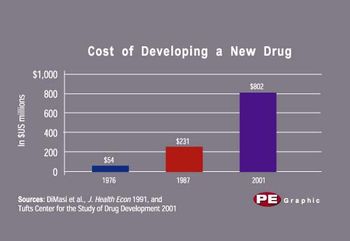
One reason new medicines are more expensive is that the cost of discovering and producing new therapies is soaring.

Pharmaceutical Executive
"You never listen to me."